Scaling algae production in Europe – Key takeaways from the EMD 2026 workshop
Europe has the knowledge and technology to build a thriving algae sector. The challenge now is turning innovation into large-scale commercial reality. So what is needed towards scaling algae production in Europe?
This question was explored in the workshop “Algae Solutions for a Thriving Blue Economy”, organised during the European Maritime Day (EMD) 2026 in Cyprus by the project SeaMark, CIRCALGAE and REALM. The session brought together around 60 participants from academia, industry and civil society to discuss how Europe can accelerate the development of sustainable algae value chains.
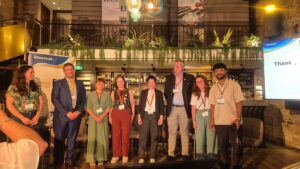
After a short welcome address by Evdokia Achilleos, Head of Sector in Unit B3 at the European Research Executive Agency, three project presentations shared insights. Ólvaur Gregersen, Amparo Jiménez Quero, and Mariana Carneiro presented their project’s technological advances, results, barriers encountered and experiences made. Afterwards, moderator Adrian Vincent lead a panel discussion with the project coordinators while workshop participants engaged in an interactive survey.
The discussion and interactive survey highlighted several common priorities that extend beyond individual projects and point towards the next steps for scaling algae production in Europe.

Mariana Carneiro, REALM coordinator and innovation manager at Necton.

Adrian Vincent, Mariana Carneiro, Amparo Jiménez Quero and Ólavur Gregersen from l. to r.
Europe is ready to scale algae production
One of the strongest messages from the workshop was that Europe already possesses extensive scientific knowledge and technical expertise in algae cultivation and processing. Rather than generating more basic research, the sector now needs to focus on implementation, industrialisation and large-scale deployment. Participants agreed that the priority should be to build on existing knowledge and translate proven technologies into commercially successful businesses.
Regulation must keep pace with innovation
Regulatory challenges emerged as one of the biggest barriers to growth. Participants highlighted that current legislation often struggles to accommodate new algae applications and differs significantly between European countries and international competitors.
Among the main concerns were lengthy novel food approval procedures, the classification of valuable side streams as waste, and stricter requirements for European producers compared to imported products. Developing regulatory frameworks that better reflect the realities of the algae sector was identified as a key priority for improving competitiveness.
Improving competitiveness starts with better economics
For algae to become a mainstream bio-based resource, production costs need to decrease while market opportunities continue to grow. Workshop participants emphasised the importance of focusing on products with strong market demand, increasing production efficiency through automation and improved cultivation techniques, and creating multiple products from the same biomass through cascading use and biorefinery approaches. Clear commercial opportunities remain essential for attracting investment and scaling production.
Several speakers stressed that algae biomass should no longer be viewed as a single product. Valuable compounds can be extracted for different applications, while remaining fractions can serve additional markets. Making full use of the biomass through circular biorefinery concepts not only improves resource efficiency but also strengthens the economic viability of algae production.
Environmental benefits deserve greater recognition
Beyond producing valuable biomass, algae systems deliver a wide range of environmental services. These include removing nutrients from water, capturing carbon, supporting biodiversity, mitigating ocean acidification and contributing to regenerative agriculture.
These ecosystem services are currently undervalued. Better life cycle assessment methodologies and standardised sustainability assessments are needed to demonstrate their full environmental impact and enable fair comparisons with conventional products.
Scaling the algae sector requires more than technology
Technology alone will not unlock Europe’s algae potential. Regulation, investment and market incentives must evolve together. Stable policy frameworks, investor confidence and public support for regenerative products are all needed to create favourable conditions for commercial growth. Clear pathways from innovation to market will be essential for accelerating investment across the sector.
Confidence in Europe's algae future
Despite the challenges, the overall outlook was highly positive. Speakers agreed that the European algae sector has made significant progress in recent years and is much closer to commercial deployment than it was only a few years ago. Growing market opportunities, maturing technologies and increasing recognition of algae’s contribution to the bioeconomy all reinforce confidence that algae will become an important pillar of Europe’s sustainable future.
From workshop discussions to policy recommendations
The discussions and recommendations from the workshop have been consolidated into a Flash Document for the European Commission. The document captures the key actions identified by participants to strengthen Europe’s algae sector and accelerate the uptake of algae-based innovations.
Explore the Flash Document and its recommendations here.
We would like to thank all participants for their engagement and the EMD organisers for the opportunity to host a workshop at the 2026 event.